Embedded controller · ammonia
Interstage pressure optimization for two-stage ammonia plants.
On two-stage ammonia, discharge temperatures are won or lost on a pressure set by the machine's actuators: the split between two stages. The AReCoS controller is designed to choose it from a physics model of the machine, on the equipment.
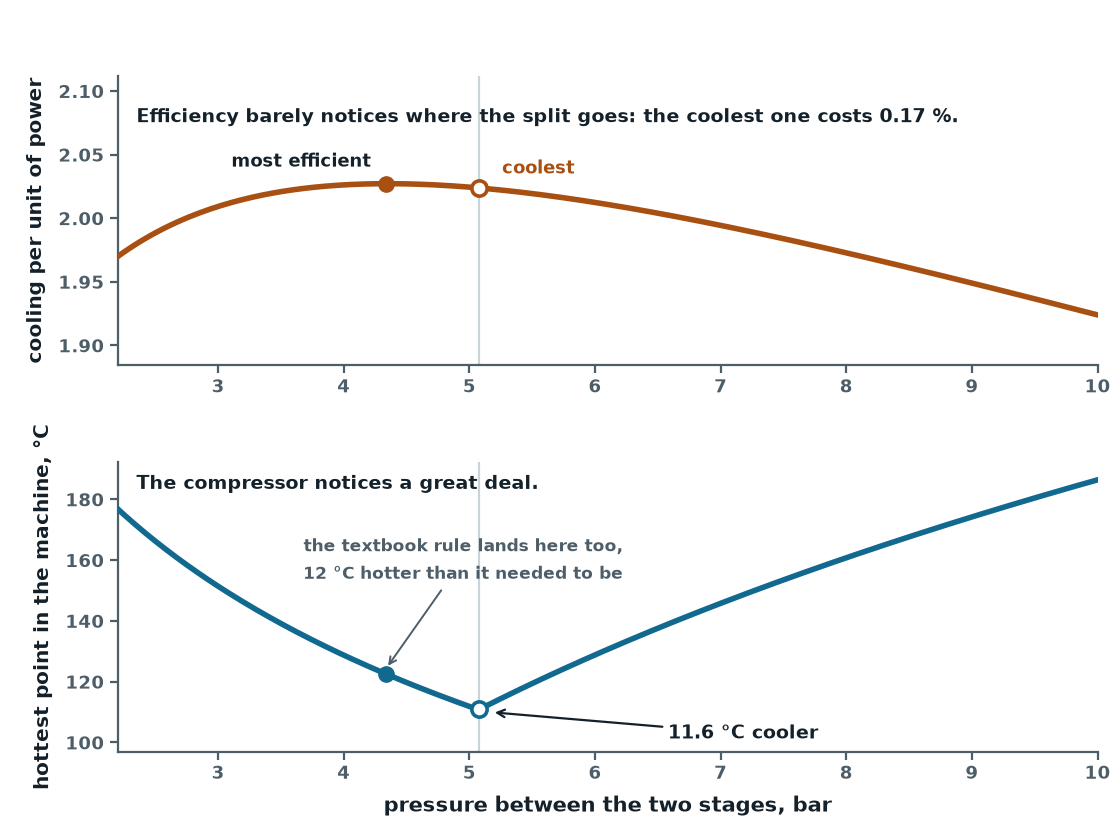
In the AReCoS cycle model, a split that takes 11.6 °C (20.9 °F) off the hottest point in the machine costs a sixth of a percent of efficiency.
- U.S. Patent 12,768,557
- A hardware test on a vapor-compression system (US 2024/0295337 A1, FIGS. 4 to 7)
- Under test in a research agreement (CRADA) with UT-Battelle, LLC, which manages Oak Ridge National Laboratory for the U.S. Department of Energy
- Patent and CRADA record
Every circuit hides a pressure someone has to choose
In an ordinary system the weather, load and fans set the condenser pressure, and the optimum is wide and flat. Run CO2 above its critical point, or compress in two stages, and a pressure appears that someone has to choose.
Ammonia
Two-stage ammonia plants
Two-stage ammonia: where to split the compression, air and water in the plant, and the grid.
Ammonia
When one stage is not enough
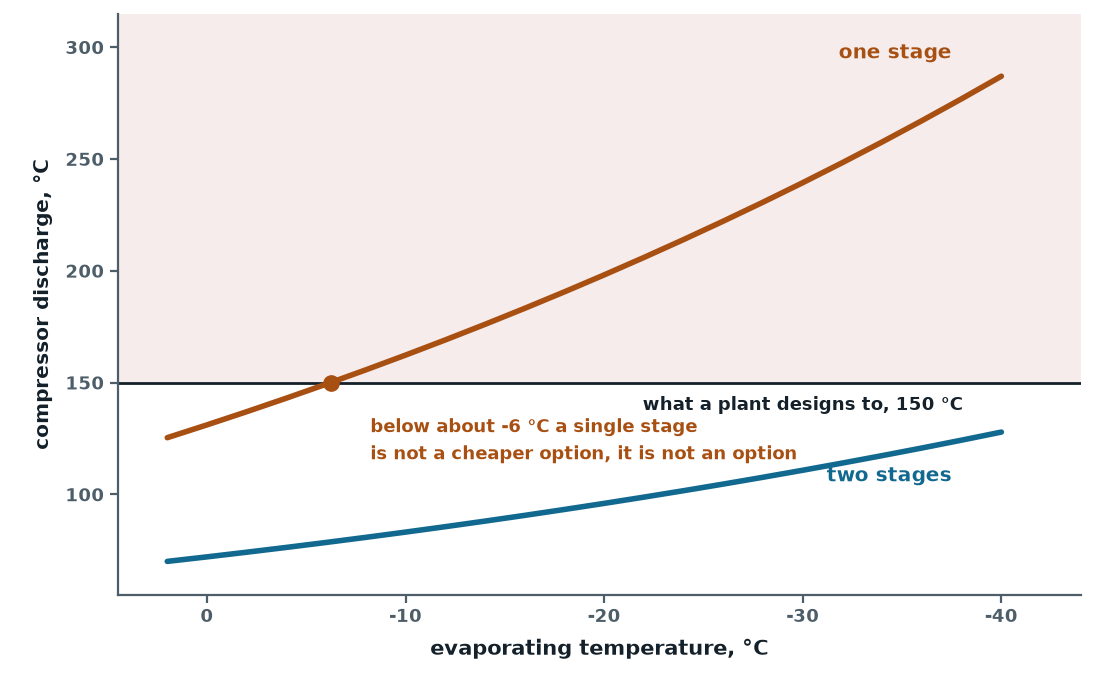
Ammonia is already the efficient choice on industrial duty. From about −26 °C (−15 °F) down, plants usually compress it in two stages, which leaves one choice: where to split the compression.
Ammonia
Nearly twelve degrees off the compressor, for a sixth of a percent, in the model
In the AReCoS model, moving the interstage pressure from the most efficient split to the coolest takes 11.6 °C (20.9 °F) off the hottest point in the machine. Efficiency barely notices: at the duty in the figure below, a sixth of one percent. A lower modeled discharge temperature may reduce thermal stress and the risk of a high-temperature trip; any effect on oil life and maintenance needs plant-level validation.
AReCoS is designed to take as many of those degrees as the plant's loads allow, and to find the coolest split without hunting for it.
Ammonia
Air in, water in, charge out
Below about −33 °C (−28 °F) ammonia boils below atmospheric pressure, so a cold plant can draw in air, and moisture with it. Air holds the condensing pressure up; water makes the coldest vessel's liquid boil warmer. Where a plant reports each vessel's pressure and liquid temperature, the controller is designed to read both faults from them, to tell either from a drifting sensor, and to count the charge.
Ammonia
When the grid asks
On two-stage ammonia, the frozen product is the store, and the controller is designed to follow the coolest split while load is cut.
One controller: efficiency on CO2, cooler compressors on ammonia
On carbon dioxide the decision buys efficiency, and it moves with the weather. On ammonia it buys cooler compressors; what that is worth in reliability is for plant tests to show. Same controller, same kind of decision, different payoff.
Ready for evaluation on your machine
The controller is available for evaluation today, fitted to your ammonia plant, and licensed per unit.
The controller is designed to make this decision on two-stage ammonia, as it does on HFC and HFO systems.
In the evaluation, AReCoS builds your machine's model from its components, fits it to your plant and checks it against your own test data.
The cycle work behind this page is the AReCoS team's own.
Let's talk.
Tell us what you run: a refrigeration system or a machine you build.
Grand Rapids, Michigan 49546