Embedded controller
Transcritical CO2
AReCoS does not build a CO2 machine. This page is about what our controller is designed to do inside one somebody else builds.
The high side stops being automatic
In an ordinary chiller nobody chooses the condenser pressure. The refrigerant condenses, and on that side pressure and temperature are the same fact: fix one and the weather fixes the other.
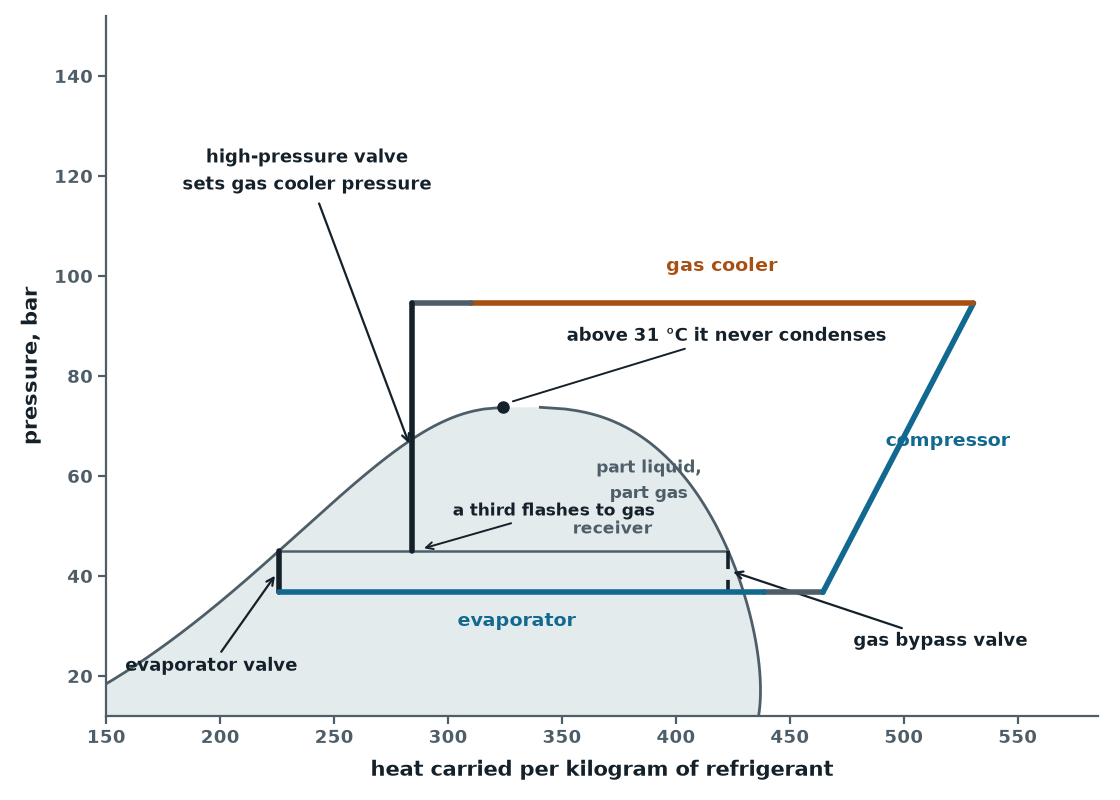
Carbon dioxide above about 31 °C (88 °F) does not condense at all. Heat leaves through a gas cooler instead, and the pressure on that side comes loose from the temperature. It stops being a consequence and becomes a decision – one the machine has to make again every time the weather moves.
The decision is worth real efficiency
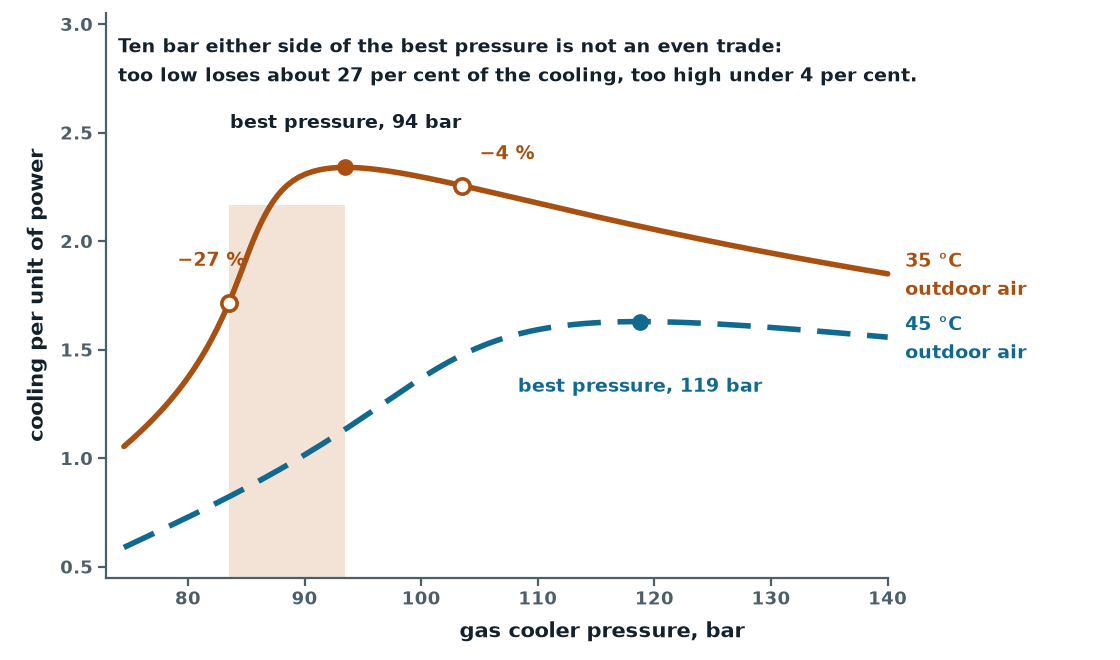
There is a best pressure, and it is sharp.
On a 35 °C (95 °F) day it sits near 94 bar. On a 45 °C (113 °F) day it has moved to about 119 bar. Missing it is not symmetric, which is the part that catches people out: ten bar above the best pressure costs under four per cent of the cooling you get per unit of power, while ten bar below costs about twenty-seven per cent. The safe side and the cheap side are not the same side.
Today that pressure is usually set from a fixed formula in the gas cooler outlet temperature, with a regulator holding it there. The formula is fitted to a cycle rather than to your machine, and it carries no sense that one side of the peak is cheap and the other expensive. Our controller is designed to work the pressure out from the machine's own condition instead, and to keep to the forgiving side while it does.
Three valves, three different jobs
A transcritical circuit has more than one expansion valve and they are not interchangeable.
The high-pressure valve after the gas cooler is the one that sets gas cooler pressure – it is the decision above, made physical. A second valve vents the gas that flashes off in the receiver, which on this refrigerant is roughly a third of everything leaving the gas cooler. Only the third valve feeds the evaporator.
Each of those valves moves the other two. Our controller is designed to set them together from one model of the machine, rather than as three loops that each discover the others by surprise. That is the same thing it is designed to do on an ordinary machine; there is simply more to coordinate here.
On a heat recovery machine the answer changes again
If the machine is also making hot water, gas cooler pressure stops having a single best value. The same number now trades cooling against heat delivered, and the right answer depends on what the building wants at that moment.
A fixed rule cannot follow that. A controller carrying a model of the machine is designed to.
What is ours today
The cycle work behind this page is our own and it is current.
A model of a CO2 machine's behaviour over time is designed work rather than delivered work: we have not yet matched one against a running CO2 unit. Our dynamic modelling has been built and exercised on the machines we know, and it is that method, not a finished CO2 product, that we would bring.
We license controllers per unit and co-develop them with the company that builds the machine. If you build transcritical CO2 equipment, the quickest way to find out what this is worth on your machine is to put it against your own test data.
Let's talk.
Tell us what you run: a refrigeration system, a chiller plant, or a machine you build.
Grand Rapids, Michigan 49546