Embedded controller
The decision changes with the refrigerant.
Every transcritical CO2 and two-stage ammonia machine carries a pressure that nothing sets for you. On one it is worth twenty-seven per cent of your cooling. On the other it is worth eleven degrees of compressor life. Our controller is designed to make that call, inside the machine you build.
Every circuit hides a pressure someone has to choose
In an ordinary chiller nobody chooses the condenser pressure. The refrigerant condenses, and on that side pressure and temperature are the same fact: fix one and the weather fixes the other.
Change the refrigerant, or the number of stages, and that stops being true. A pressure appears that nothing sets for you. What it is worth to get right is not the same from one machine to the next – and that, rather than any one number, is the case for a controller that carries a model of the machine it is in.
Carbon dioxide
The high side stops being automatic
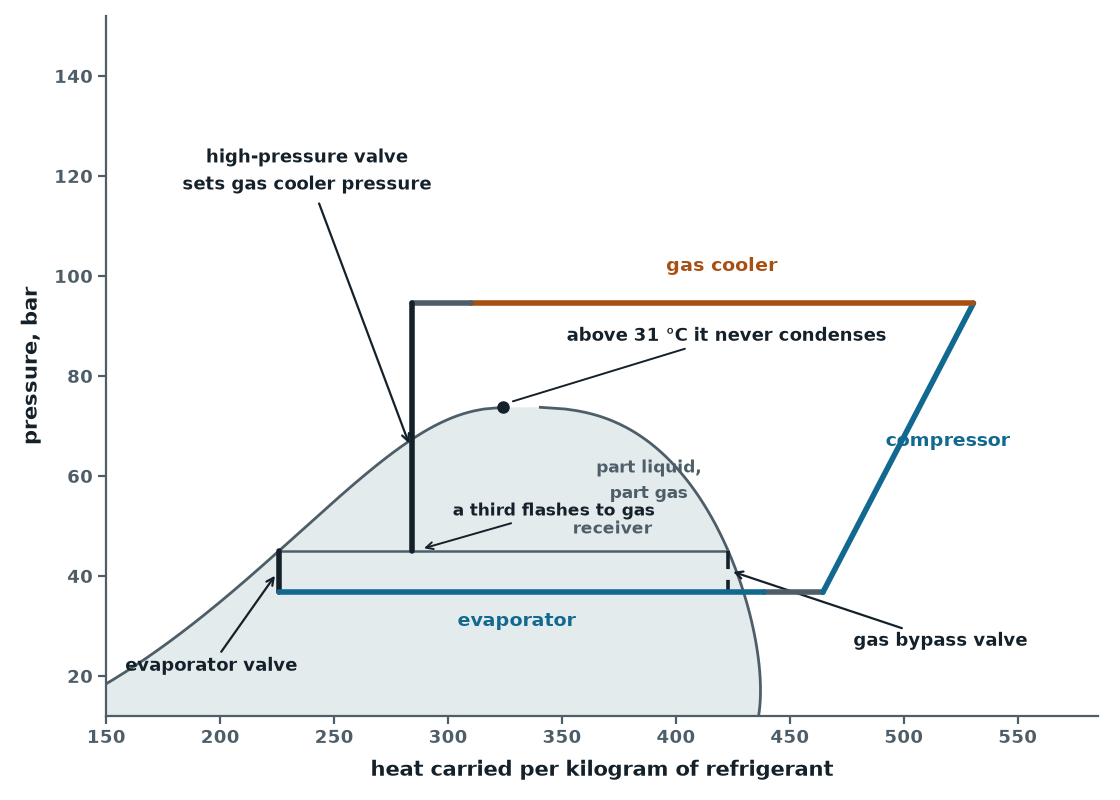
Carbon dioxide above about 31 °C (88 °F) does not condense at all. Heat leaves through a gas cooler instead, and the pressure on that side comes loose from the temperature. It stops being a consequence and becomes a decision – one the machine has to make again every time the weather moves.
Carbon dioxide
And the decision is sharp, and lopsided
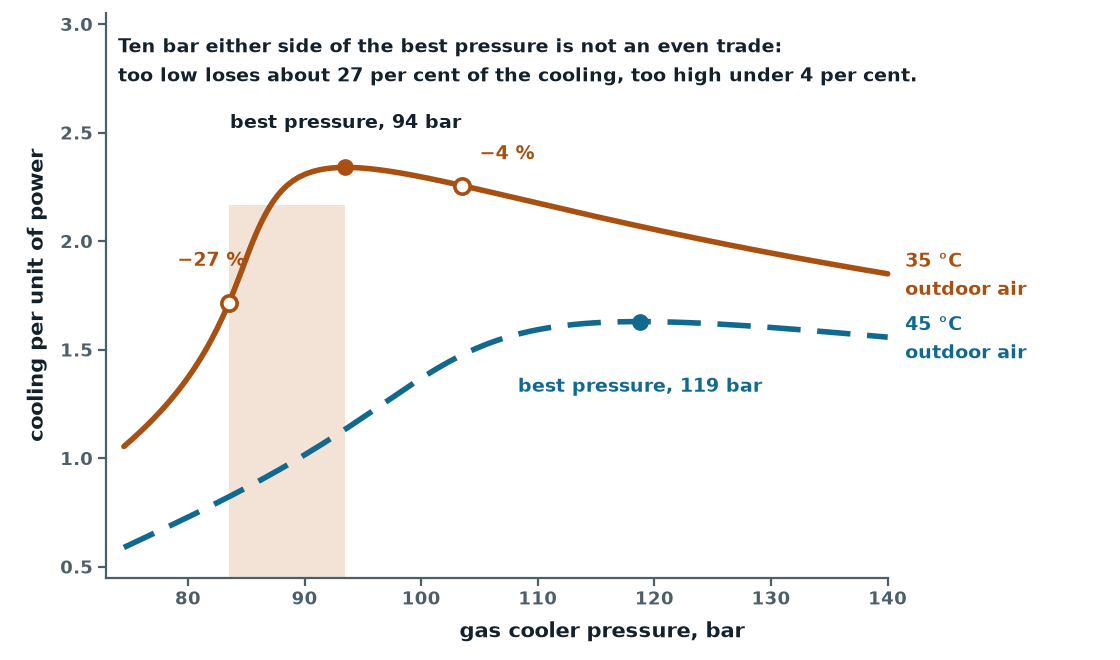
There is a best pressure, and it is sharp. On a 35 °C (95 °F) day it sits near 94 bar. On a 45 °C (113 °F) day it has moved to about 119 bar. Missing it is not symmetric, which is the part that catches people out: ten bar above the best pressure costs under four per cent of the cooling you get per unit of power, while ten bar below costs about twenty-seven per cent. The safe side and the cheap side are not the same side.
Today that pressure is usually set from a fixed formula in the gas cooler outlet temperature, with a regulator holding it there. The formula is fitted to a cycle rather than to your machine, and it carries no sense that one side of the peak is cheap and the other expensive. Our controller is designed to work the pressure out from the machine's own condition instead, and to keep to the forgiving side while it does.
Carbon dioxide
Three valves, three different jobs
A transcritical circuit has more than one expansion valve and they are not interchangeable. The high-pressure valve after the gas cooler is the one that sets gas cooler pressure – it is the decision above, made physical. A second valve vents the gas that flashes off in the receiver, which on this refrigerant is roughly a third of everything leaving the gas cooler. Only the third valve feeds the evaporator.
Each of those valves moves the other two. Our controller is designed to set them together from one model of the machine, rather than as three loops that each discover the others by surprise.
Ammonia
The limit is the compressor, not the power bill
Ammonia is already the efficient choice on industrial duty, and it moves about a sixth of the mass through the pipes to do it. Efficiency is not the problem. What compression does to it is.
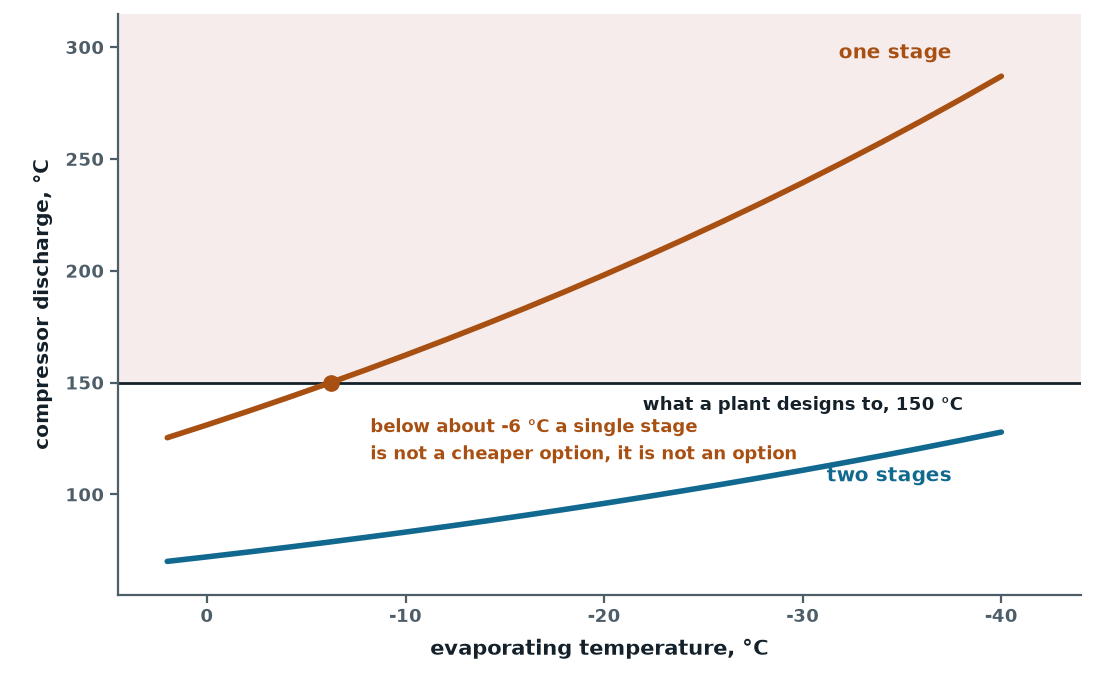
Compress ammonia hard and it gets very hot. Chilling to 2 °C (36 °F) against a 40 °C (104 °F) condenser leaves the compressor at about 125 °C. Take the evaporator to −30 °C and a single stage would leave at 239 °C; at −40 °C, 287 °C. Oil and valve plates do not survive that.
So below about −6 °C evaporating, a single-stage machine is not a cheaper option. It is not an option. The plant is two-stage because of temperature, and the efficiency is a side effect. Which leaves one question: where to split the compression.
Ammonia
Eleven degrees off the compressor, for nothing
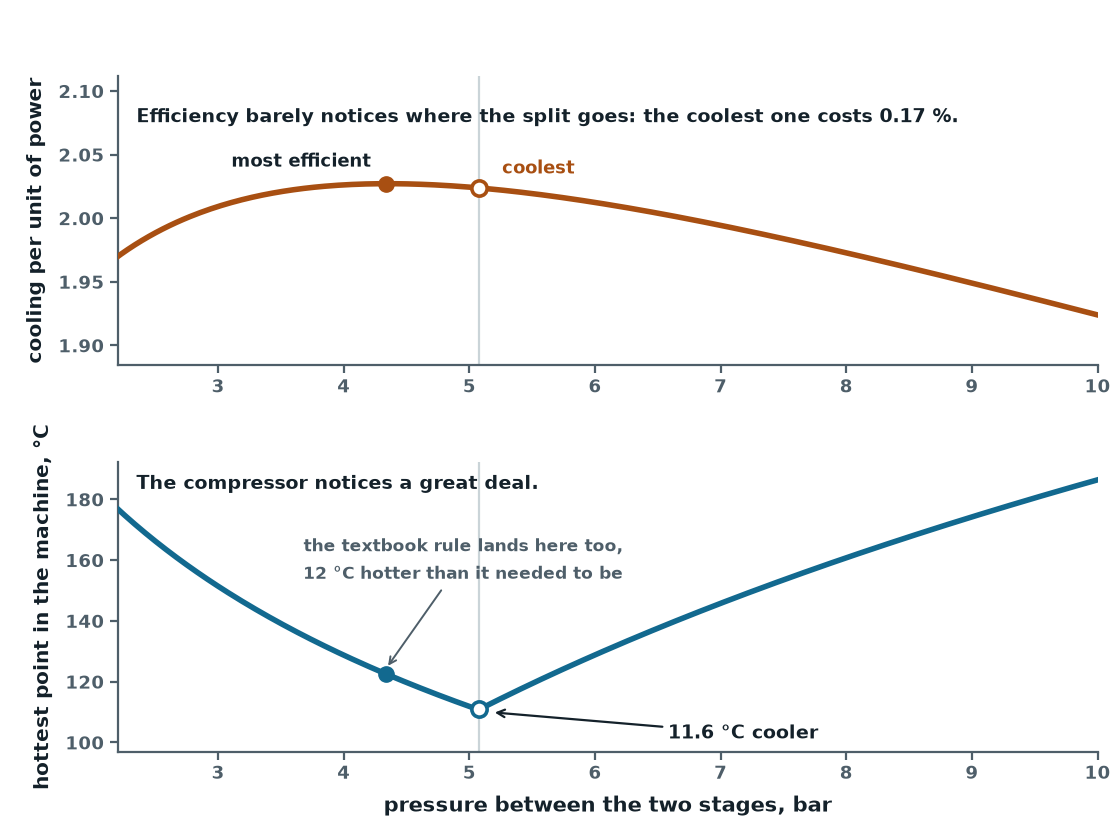
Move the interstage pressure from the point that gives the most cooling per unit of power to the point that runs the machine coolest, and the hottest point in the machine falls by eleven and a half degrees. Efficiency barely notices: at the duty in the figure below, those degrees cost a sixth of one per cent.
Degrees off a compressor are not an efficiency number. They are oil life, the interval between services, and the shutdown that does not happen. A sixth of a per cent for them is not a trade. It is free.
Our controller is designed to take it, and to find it without hunting: at the coolest split the two stages run exactly as hot as each other, so driving the difference between their discharge temperatures to zero lands on the right pressure by construction.
The rule of thumb a plant reaches for lands on the efficient split and none of the degrees, and the gap grows with lift: five degrees at 2 °C, fifteen at −40 °C.
One controller, two different things it hands you
On carbon dioxide the decision buys efficiency: twenty-seven per cent of your cooling, and it moves with the weather. On ammonia it buys reliability: eleven and a half degrees off the hottest point in the machine, for a sixth of one per cent. The same controller, the same kind of decision, opposite currencies.
The two machines are at different duties, and deliberately so – each refrigerant is shown where its machines are actually built. Transcritical CO2 does chiller duty; a two-stage ammonia plant exists because of low-temperature duty, and at chiller duty it would not be built in two stages at all. The ammonia result does not rest on that: run it at the carbon dioxide machine's own 2 °C and the coolest split still costs three tenths of a per cent, and still buys nine degrees.
On a CO2 machine that is also making hot water it stops having a single best value at all: the same pressure now trades cooling against heat delivered, and the right answer depends on what the building wants at that moment.
A formula fitted to one of those machines carries no sense of any of the others. A controller carrying a model of the machine it is actually in is designed to tell them apart.
What is ours today
The cycle work behind this page is our own and it is current.
A model of either machine's behaviour over time is designed work rather than delivered work: we have not yet matched one against a running CO2 unit or a running ammonia plant. Our dynamic modelling has been built and exercised on the machines we know, and it is that method, not a finished product on either refrigerant, that we would bring.
We license controllers per unit and co-develop them with the company that builds the machine. If you build transcritical CO2 or two-stage ammonia equipment, the quickest way to find out what this is worth on your machine is to put it against your own test data.
Let's talk.
Tell us what you run: a refrigeration system, a chiller plant, or a machine you build.
Grand Rapids, Michigan 49546